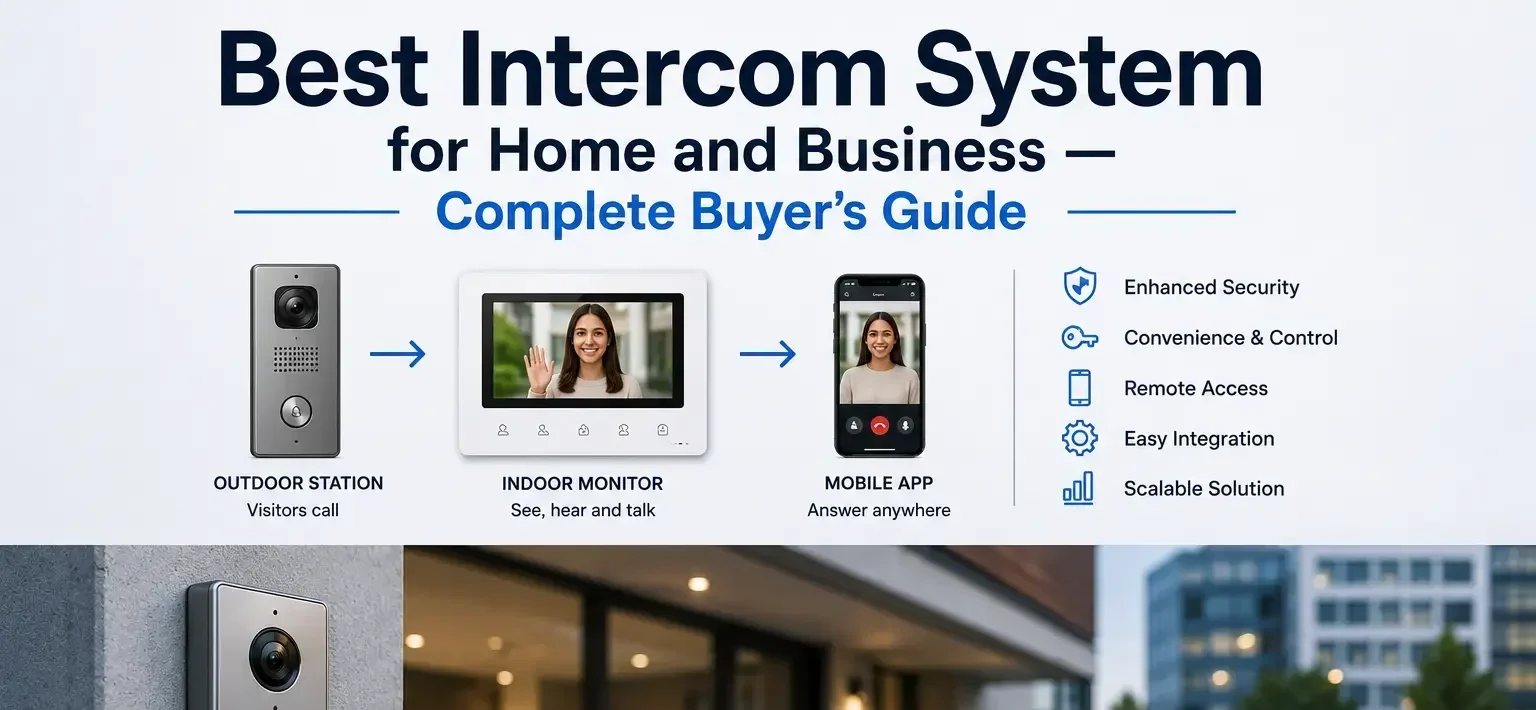

The right entry solution should fit the building, the number of users, and the way visitors are admitted. Homes often benefit from video calling and smartphone access, while apartment buildings and businesses usually need wired IP equipment with centralized management. In Massachusetts, exterior stations should also be selected for snow, moisture, and wide temperature changes. Proper installation improves call quality, door control, and long-term reliability.
Best Intercom System for Home and Business
The most suitable entry setup is not always the most expensive or feature-heavy option. A good choice is one that matches the property, supports the right number of users, and handles visitor entry without creating unnecessary complexity.
A single-family home may only need one entrance station, clear video, and mobile answering. An apartment building may require a tenant directory, multiple call destinations, and simple resident updates. A commercial property may need several doors, reception routing, event records, and integration with employee access.
This guide explains the main system types, the differences that matter in practice, and the best fit for common residential and commercial settings.
What Is an Intercom System and How Does It Work?
The equipment allows two-way communication between a visitor and someone inside the building or at a remote location. Depending on the setup, the recipient may answer from a wall-mounted monitor, desk station, phone, tablet, or security console.
At a basic level, the setup includes an exterior call station, a receiving device, power, and a connection to the door or gate. More advanced intercom systems can also display live video, call several people in sequence, store activity records, and release an electronic lock.
The purpose is simple: identify the visitor, communicate before entry, and control access more safely than opening a door without verification.
Audio vs. Video Intercom — Key Differences
An audio intercom carries voice only. It can be a practical option for internal communication, service counters, side entrances, and older properties where the available wiring does not support video.
A video intercom adds visual confirmation. The person answering can see the visitor, review the area around the entrance, and decide whether access should be granted. This is especially useful for deliveries, contractors, guests, and shared building entrances.
The value of video depends on more than resolution. Camera angle, mounting height, lighting, glare, nighttime visibility, and weather exposure all affect the image. A lower-resolution unit installed correctly can be more useful than a higher-resolution device pointed at the wrong area.
For most primary entrances, video is the stronger choice. An audio intercom remains useful where visual identification is unnecessary or infrastructure is limited.
Intercom Systems vs. Video Doorbells
A video doorbell is usually intended for one household and one entrance. It sends an alert to a mobile device, provides two-way communication, and may record motion or calls.
Intercom systems are designed for a broader range of entry situations. They may serve multiple apartments, several office departments, a receptionist, a guard station, or a gatehouse. They can also connect directly to door hardware and support more structured call routing.
That type of device may be enough for a simple front-door setup. A full door entry system is usually better when the property needs several users, direct lock release, tenant directories, internal stations, or integration with building security.
Types of Intercom Systems
The main categories are based on how the devices communicate, how they receive power, and whether they operate independently or as part of a larger access platform.
Wired Intercom Systems — Reliability for Large Properties
A wired intercom system uses physical cable between the entrance station, receiving devices, controller, and door hardware. In newer installations, this may be structured network cable rather than older dedicated intercom wiring.
The main advantage is consistency. A wired intercom system is less dependent on local wireless coverage and is often easier to support with backup power. This makes it a strong choice for apartment buildings, offices, schools, and facilities with several entrances.
The challenge is installation. Cable may need to pass through walls, ceilings, risers, basements, utility rooms, or underground conduit. Existing cable can sometimes be reused, but only after its condition and capacity have been checked.
A wired intercom system is usually the right long-term choice when the building has many users, heavy traffic, or plans to expand.
Wireless Intercom Systems — Flexibility for Homes
A wireless intercom system sends communication through Wi-Fi, radio, cellular service, or a combination of technologies. It can reduce the need for new communication cable and is often suitable for houses, small offices, detached garages, and retrofit projects.
However, wireless does not mean that every part is battery-operated. The entrance station still needs power, and an electronic lock requires a dependable power and control connection.
Before choosing a wireless intercom system, signal strength should be tested at the exact mounting location. Exterior walls, metal doors, masonry, long driveways, and detached gates can all weaken coverage.
A wireless intercom system is most useful where the property has stable connectivity, a limited number of stations, and a strong need for mobile answering.
IP Video Intercom Systems — Best for Commercial Use
An IP intercom system carries voice, video, and control data over an Ethernet network. Many devices can also use Power over Ethernet, which allows one network cable to deliver both data and power.
This architecture is well suited to commercial buildings because it supports centralized management, multiple entrances, remote configuration, and flexible call routing. Calls can be sent to reception, security, selected employees, mobile devices, or different groups at different times.
An IP intercom system can also be easier to expand than an older analog setup, provided the network has enough capacity and the switches, addressing, and power have been planned correctly.
For offices, mixed-use buildings, campuses, and growing facilities, an IP intercom system is often the most adaptable option.
Intercom Systems Integrated with Access Control
An intercom with access control combines visitor communication with controlled entry. A visitor may call a resident or staff member, while regular users enter with a card, code, mobile credential, or another approved method.
This arrangement avoids running two disconnected systems at the same entrance. It also allows communication, unlocking, and user permissions to follow one coordinated access plan.
An intercom with access control must be designed around the door itself. The installer needs to consider the lock, door position sensor, exit hardware, power supply, emergency release requirements, and what should happen if the network or power fails.
KeyTechPros can connect intercom equipment with compatible access control systems so the communication and unlocking functions work together rather than as separate pieces.
How to Choose the Best Intercom System
The selected equipment should solve the actual access problem without adding features the property will not use. The decision should be based on users, entrances, infrastructure, weather exposure, and management needs.
Key Features to Compare: Video, Range, Weather Rating, App Integration
Video quality matters, but field of view and placement matter just as much. The camera should show the visitor’s face and enough of the surrounding area to provide context.
Range is especially important for wireless equipment. Homes with detached garages, long driveways, or gates may need network extensions, cellular communication, or a point-to-point connection.
Outdoor stations should have a suitable weather rating. In Massachusetts, snow, freezing rain, wind-driven moisture, road salt, and repeated freeze-thaw cycles can affect exposed hardware. A protected mounting position, proper sealing, and suitable cable entry are important.
Power source is another key factor. Battery devices are convenient but require charging or replacement. Hardwired power is usually better for high-use entrances, locks, and larger buildings.
A smartphone intercom allows calls to be answered away from an indoor station. Useful functions may include multiple users, remote unlocking, scheduled call routing, and shared administration.
The system should also be easy to manage. Adding a tenant, removing an employee, changing a call destination, or updating a schedule should not require unnecessary service work.
Wired vs. Wireless: Which Is Better for Your Property?
Wired equipment is generally better when reliability, multiple entrances, frequent use, and long-term expansion are priorities. It is often the best fit for new construction, renovations, apartment buildings, and commercial properties.
Wireless equipment is useful where new cable would be highly disruptive and the property has dependable coverage. It can work well for houses, small professional offices, and secondary entrances.
A hybrid design may combine the strengths of both. For example, the entrance station may use wired power and lock control while users answer through mobile devices.
The best choice should follow a site assessment rather than a general assumption that one technology is always superior.
Best Intercom Systems by Use Case
The most useful recommendation is one tied to the building and the people who use it. The following guidance focuses on system type rather than brand or product model.
Best Intercom System for a Single-Family Home
For most houses, the best intercom system is a video setup with hardwired power, mobile answering, and optional indoor monitors. It should provide clear two-way communication, useful video, and remote door or gate release where compatible hardware is installed.
A wireless option can be practical in a finished home where running cable would cause major disruption. Even then, Wi-Fi strength and the power requirements of the entrance and lock should be checked first.
Homeowners who receive frequent deliveries may benefit from call history or event recording. Families may also prefer both an indoor screen and mobile access so the entrance does not depend on one person’s phone.
Best Video Intercom for Apartment Buildings
The best video intercom for a multifamily property is usually a scalable wired or IP-based platform with a tenant directory, mobile calling, door release, and simple resident administration.
An apartment intercom system should make move-ins and move-outs easy to manage. Building staff should be able to add or remove residents, update names, and change call destinations without replacing labels or visiting every apartment.
Older Boston buildings may have thick masonry, crowded risers, legacy buzzer cable, and limited space for new equipment. A survey can determine whether existing pathways are usable or whether a hybrid retrofit makes more sense.
The best video intercom should also handle the daily realities of shared entrances: deliveries, contractors, visitors, resident turnover, and periods of heavy call volume.
For a larger apartment intercom system, administration is as important as camera quality. A platform that is difficult to update can create ongoing work for property management.
Best Commercial Intercom System for Offices and Businesses
The best commercial intercom system is usually an IP-based platform connected to reception, security, or selected employee devices. It should route calls reliably, provide visual verification, and release the correct entrance without forcing staff to leave their work area.
A small office may only need one entrance station and a few answering points. A larger business may require several doors, call groups, schedules, event records, and centralized management.
A commercial intercom system should be selected together with the network and access plan. This helps avoid conflicts between the entrance station, lock hardware, switches, permissions, and visitor procedures.
Businesses with multiple suites or buildings may also need call transfer, department routing, or remote administration from one location.
Intercom Systems for Gated Facilities and Parking
Gates create different requirements from building entrances. The station must be reachable from a vehicle, positioned away from moving gate components, and protected from direct impact and weather.
A wired connection through conduit is usually the most dependable option for a permanent gate. Where trenching is impractical, wireless or cellular communication may work, but it should be tested under real site conditions.
The door entry system may call a residence, guard station, leasing office, or remote operator. In commercial parking, it may also coordinate with credential readers, vehicle detection, cameras, and scheduled access.
Outdoor hardware should be selected for the exact exposure of the site. A station under a canopy faces different conditions from one installed beside an open driveway.
Advantages of a Professional Intercom Installation
A professional installation involves more than mounting a panel and connecting an app. The installer has to make communication, video, power, locking hardware, and user permissions work as one complete entry process.
Why DIY Intercom Setup Often Falls Short
DIY equipment can be suitable for a simple battery-operated device at one uncomplicated door. Problems usually appear when the project includes several users, an electronic lock, long cable runs, weak wireless coverage, outdoor exposure, or integration with other security equipment.
Common issues include poor camera placement, voltage drop, unstable Wi-Fi, incorrect relay wiring, unprotected cable openings, and mobile permissions that were never configured properly.
A system may seem functional during a quick test but fail during heavy use, a power interruption, severe weather, or a change in users.
A professional installer can ensure the door, wiring, network, power supply, camera, call routing, and unlocking function are tested as one system.
Intercom Installation in Massachusetts — What to Expect
A typical project begins with a site review. The technician checks entrances, existing cable, door hardware, network availability, power, user numbers, and the locations where calls should be received.
The design stage defines station placement, cable routes, lock control, mobile users, call groups, and any required integration. Installation then includes mounting equipment, running or reusing suitable cable, connecting power and door hardware, programming directories, and testing audio, video, notifications, and unlocking.
Outdoor units should also be positioned and sealed for local conditions rather than installed only according to appearance.
KeyTechPros provides intercom installation services for homes, apartment buildings, offices, and gated properties. For intercom installation Massachusetts property owners can rely on, the recommendation should be based on the actual building rather than a generic product list.
Choose the Best Intercom System for the Property
The right choice matches the entrance, users, infrastructure, and access rules of the site. A house may need mobile video and one dependable door release. An apartment building may need tenant management and scalable calling. A business may require network integration, reception routing, and several controlled entrances.
KeyTechPros can assess the property, recommend a suitable design, and complete professional intercom installation with the wiring, configuration, integration, and testing needed for dependable daily use.